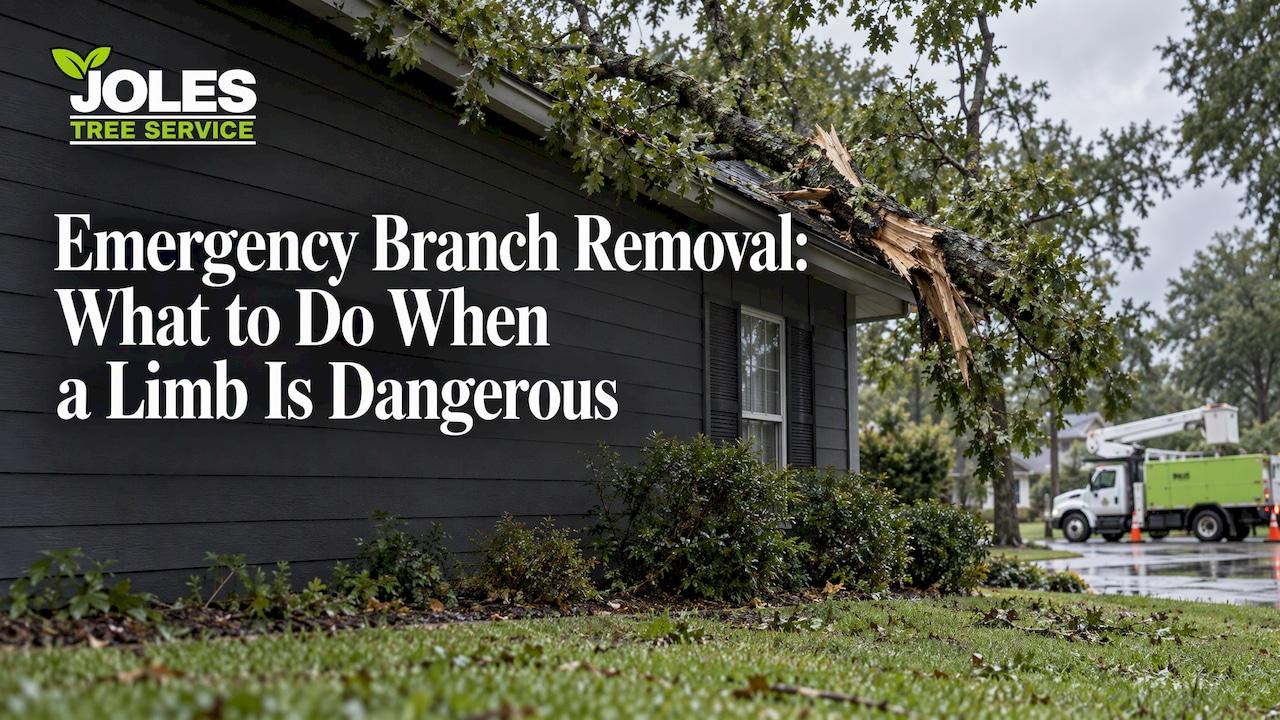
A broken limb hanging over your roof, driveway or kids' play area is a problem for a licensed arborist, not a weekend project. Wood under tension can snap and swing without warning, and a limb that looks small from the ground can weigh hundreds of pounds. If you're in Baton Rouge, Prairieville or the surrounding parishes, our emergency tree removal service is backed by a licensed Louisiana arborist who evaluates the limb on site and defines a clear scope for your property before work begins.
This guide covers how to tell a true emergency from a job that can wait a few days, what to do in the first hour, what to do if a limb touches a power line, and what affects the price.
TL;DR
- A limb is an emergency when it is broken and hanging, cracked at the union with the trunk, or sitting over a house, car, walkway or power line.
- Keep people and vehicles out from under it, photograph the damage, and do not climb, pull or saw it yourself.
- If a branch touches or tangles with a power line, stay away and call your electric utility. Never cut it.
- In Louisiana, anyone who prunes or removes trees for a fee needs an arborist license, so confirm it before anyone starts.
- Emergency work costs more than preventive trimming, so inspecting trees before hurricane season is the cheapest insurance.
Table of Contents
- What counts as an emergency limb
- What to do in the first hour
- If the limb is touching a power line
- Why a licensed arborist matters in Louisiana
- What a professional does differently
- What emergency branch removal costs
- Preventing the next emergency
- Emergency help in Baton Rouge and Prairieville
- FAQ
- Sources
What counts as an emergency limb
Not every broken twig needs a crew at your door. The question is what the limb can hit and how likely it is to fall.
The Nebraska Forest Service lists the storm-damage hazards homeowners should check for: loose or broken branches that should be removed before they fall, split trunks that are likely to fail in a later storm, and trunks or limbs that have lost more than a third of their circumference. Those can't be adequately repaired. A tree that has newly started to lean points to major root failure.
In practical terms, treat it as an emergency when you see any of these:
- A hanger. A broken limb snagged in the canopy, held up by other branches. These are the ones that come down on someone.
- A fresh split or crack where a large limb joins the trunk, especially with exposed pale wood.
- A limb resting on or pressing against the house, garage, fence, vehicle or service line.
- A limb over a driveway, sidewalk, play area or the path to your door that blocks access or threatens people.
- Anything touching or near a power line.
Rhode Island's Department of Environmental Management adds a few signs that a whole tree, not only a limb, is the problem: a cracked or broken lower trunk, a large stem split from the tree, a tree newly leaning toward something valuable, or major roots severed or broken. If you see those, the question changes from "remove the branch?" to "remove the tree?" That is a call for an arborist.
When it can wait
Small broken branches with no one beneath them, no contact with the structure and no power line nearby are usually not urgent. Utah State University Extension says minor damage such as small broken branches can be handled without professional help, but with extreme caution, and that broken branches should be cut back to where they join a larger healthy branch. If you're not sure whether yours is minor, assume it isn't and have it looked at.
What to do in the first hour
The goal in the first hour isn't to fix anything. It is to keep anyone from being hurt and to protect your claim.
- Move people and cars away. Keep everyone out from under and beside the limb, including the zone where it would swing or roll if it fell. Rope off the area or park a vehicle across the walkway if you need a barrier.
- Look up before you look around. Check for wires first. If any limb is near a line, skip to the power-line section below.
- Photograph everything from a safe distance. UConn Extension recommends photographing damage before removal to support insurance claims. Get wide shots of the tree, the limb and whatever it hit, plus close-ups of the break.
- Don't try to hold it up. The Nebraska Forest Service advises against supporting damaged trees with rope, cable, wire or bolts. It also warns against topping, and against using paint or wound dressing on wounds. None of these makes the tree safer.
- Call a licensed arborist and describe what you see: the size of the limb, what it's over, and whether it's hanging or on the ground.
Why the do-it-yourself saw is the wrong tool
Storm-damaged wood is unpredictable. Utah State warns that branches bent under tension or compression can shift, break and be thrown or fall while you cut them, causing injury. UConn Extension says chainsaw work should never be done without thorough knowledge of safe procedures and proper protective equipment: at minimum a hardhat, chaps, eye and hearing protection, safety-toe boots and gloves.
A ladder and a chainsaw, with a limb overhead, is the worst combination in tree work. A trained crew rigs the limb, controls where it goes and removes it in sections. That is the difference between a clean job and a damaged roof or an emergency room visit.
If the limb is touching a power line
This is the one situation where you do nothing but call.

Maine's Department of Agriculture, Conservation and Forestry states plainly: never attempt to remove a tree or branch entangled with a power line, and contact the local power company. Rhode Island DEM adds that downed utility lines, or trees and limbs over power lines, should be reported to the utility or 911, and that only qualified line-clearance arborists should work near electrical utilities. The Nebraska Forest Service says the same: special training is required by law to prune branches over power lines safely.
For you, that means:
- Assume any wire on the ground, or any limb touching a wire, is energized.
- Stay well back, and keep children and pets away.
- Call your electric utility to report it. If someone is in danger or a wire is down across a road or driveway, call 911.
- Once the utility has made the line safe, a licensed arborist can remove the rest of the tree work on your side of the line.
In the Baton Rouge area, where many yards have mature oaks and pines growing near service lines, this comes up after nearly every major thunderstorm.
Why a licensed arborist matters in Louisiana
After a storm, crews with a truck and a saw show up unasked. Some are skilled. Some are not licensed or insured, and you only find out when something goes wrong.
In Louisiana, the Department of Agriculture and Forestry says an arborist license is required to make recommendations or perform tree removal, pruning and trimming, and that licenses are required for anyone who works on trees for a fee. Ask who holds the license on the job and confirm it before work starts.
Insurance is the other half. A report from 6abc in Philadelphia warns that homeowners insurance won't pay for an unlicensed contractor, and won't cover a lawsuit if an unlicensed, uninsured worker is hurt on your property. That is a Pennsylvania news story, but the logic of liability applies in any state: if the person on your roof isn't covered, you may be the one who's exposed.
Our team works under a licensed Louisiana arborist. That backing means the person who judges the limb, decides how it should come down and sets the scope is a credentialed professional, not whoever happens to be holding the saw.

What a professional does differently
Emergency removal looks simple from the street: a limb comes down. The work behind that includes several decisions you can't see.
- Assessing the whole tree. A limb that failed may point to decay, a weak union or root trouble. The arborist checks whether the rest of the tree is safe, not only the part on the ground.
- Deciding how it comes down. Hung-up limbs and those over structures are typically lowered in pieces with ropes rather than dropped.
- Making clean cuts. Utah State says broken branch stubs should be removed to help the tree heal, and that a stressed tree with fresh wounds may attract insects and diseases. A proper cut back to the branch collar gives the tree its best chance.
- Judging whether the tree is worth keeping. Utah State advises that if 50% or more of the canopy is undamaged, the tree should recover; if more than half is damaged, consider a professional and possible removal.
That last judgment is why an on-site evaluation matters. Our licensed arborist services cover exactly that: looking at the tree, explaining what is wrong, and recommending whether to remove the limb, trim the tree or take it down.
How much can come off a tree
This is a common question outside emergencies. The ANSI A300 pruning standard says not more than 25% of foliage should be removed in one growing season. Storm breakage doesn't follow that rule, because the tree has already lost the limb. But it explains why a crew will often remove only the damaged limb and schedule corrective pruning later rather than taking off everything at once.
To help the tree recover after a storm, Utah State also suggests watering injured trees to reduce stress. It cautions that firewood from storm-cut trees may spread insects or diseases to healthy trees nearby, so ask your crew how to handle the wood.
What emergency branch removal costs
We don't publish fixed prices. Each job is quoted after an on-site evaluation, because the same limb costs very different amounts depending on where it is. Factors that change the price:
- Access. A limb over a fenced backyard with no truck access takes more labor than one over a front lawn.
- What it's over. Work above a roof, pool or wires needs more rigging and care.
- Size and condition. Heavy, split or tension-loaded wood takes longer and is riskier.
- Cleanup and hauling. Chipping, hauling and, if the stump or tree is coming out, grinding.
- Timing. Rush work after a storm is priced differently from a scheduled visit.
To give you a sense of the gap between emergency and planned work, 6abc reported that removing trees that had fallen on power lines cost about $1,500, versus about $300 for earlier preventive trimming. Those are Philadelphia-area numbers from one storm, not Louisiana quotes, but the proportion makes the point: a limb that is trimmed on your schedule is far cheaper than one that falls on your schedule.
If damage involves your home, keep your photos, your estimate and any receipts, and ask your insurer what your policy covers for debris removal. Policies differ, and your agent is the person to confirm it.
Preventing the next emergency
Most emergency limbs were warning signs weeks or months earlier. Walk your yard after each storm season and look for:
- Dead, brittle or leafless limbs in a tree that is otherwise leafy.
- Cracks, or two stems rubbing at a tight V-shaped union.
- Mushrooms or soft, crumbly wood at the base, which may point to decay.
- Limbs that hang over the roof, or extend toward service lines.
- A tree that has begun to lean, or soil heaving at its base.
When you find one, a scheduled visit for tree trimming and pruning removes the weak limb on your terms, at a calmer pace and typically a lower price than rush work. If the evaluation shows the whole tree is compromised, tree removal is the safer option, and stump grinding can follow once it is down.
Timely trimming is also the most useful thing you can do before the Gulf Coast storm season. A tree with weak limbs removed in spring is less likely to drop one on your house in August.
Emergency help in Baton Rouge and Prairieville
When a limb is already down or hanging, you need a licensed arborist to look at it quickly and tell you what the job involves. We serve homeowners in Baton Rouge, Prairieville, Gonzales, Sorrento and the surrounding Ascension, East Baton Rouge and West Baton Rouge parishes, and our customers describe fast response times in emergencies.
Our emergency tree removal covers hazardous limbs and trees, with an on-site evaluation and a clear, property-specific scope before work begins. If you would rather have a limb assessed before it becomes urgent, the evaluation and advice are part of our arborist services.

To request help, start at our emergency tree removal page. You can also browse all tree care services.
FAQ
Who do I call for a dangerous tree limb?
Call a licensed arborist if the limb is hanging, cracked, or over your house or driveway. If it touches a power line, call your electric utility first, and 911 if someone is in danger or a wire is down. Don't approach it yourself.
Can I cut a broken branch myself?
Only small, low, minor breaks, and only with proper protective gear and extreme caution, according to university extension guidance. Anything large, overhead, hanging, under tension or near wires needs a professional.
How do I know if a tree limb is about to fall?
Look for cracks at the union with the trunk, a limb that is broken and hanging, large sections of dead or bark-less wood, and a leaning tree. A split trunk or a limb that has lost more than a third of its circumference is a serious hazard, according to the Nebraska Forest Service.
Is emergency limb removal covered by homeowners insurance?
It depends on your policy and on what the limb damaged. Photograph the damage before anything is moved, keep your estimate, and ask your insurer what it covers. Coverage may also depend on the contractor being licensed.
Sources
- Recognizing & Correcting Tree Hazards, Nebraska Forest Service
- Trees After the Storm: Planning Your Response, Rhode Island DEM
- Addressing Tree Damage Following a Storm, USU Extension
- Dealing with Wind and Storm Damaged Trees, UConn Extension
- Storm cleanup guidance, Maine DACF
- Arborist licensing, Louisiana Department of Agriculture and Forestry
- Check your contractor, insurance in aftermath of windstorm, 6abc
- ANSI A300 Part 1 pruning standard (2008)